Finishes
Iridescent Without the Glitter: Finishes That Shift Softly in Daylight
Pearl, opal glass, lustre glazes and shot fabrics: iridescent finishes that shift softly in daylight, why they change colour, and how to use one calmly.
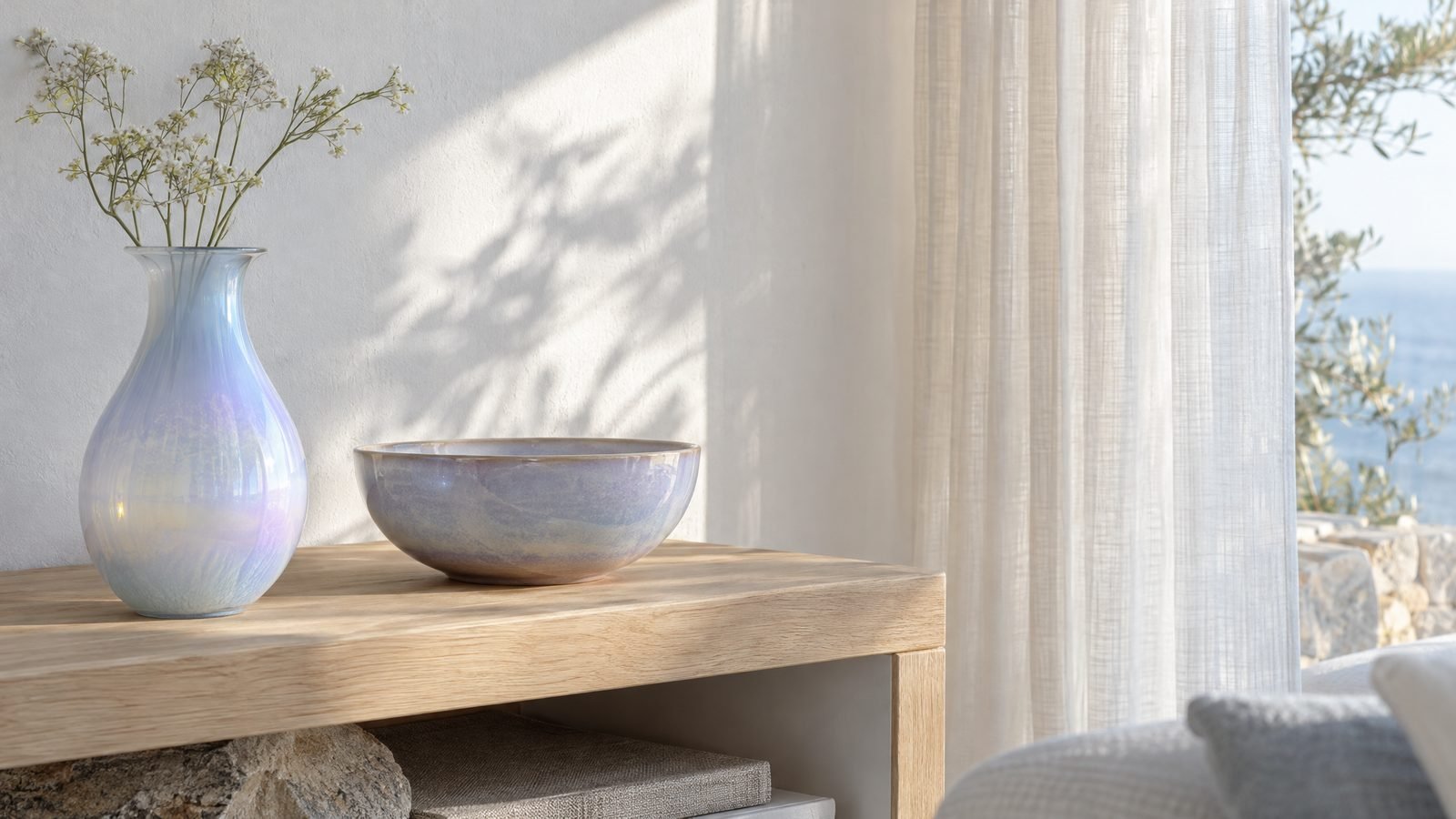
Glitter sparkles in tiny points. Iridescence flows. It is the soft shift you see on a soap bubble, the inside of a shell or a pigeon's neck: blue becoming lilac becoming silver as you move. In a home, that slow shift is far calmer than sparkle, and it is the heart of the Extra Celestial look.
Why iridescent things change colour
Most iridescent surfaces are made of very thin layers. When light hits them, some bounces off the top layer and some off the layers below. These reflections mix, and certain colours grow stronger while others cancel out. Change the angle, and a different colour wins.
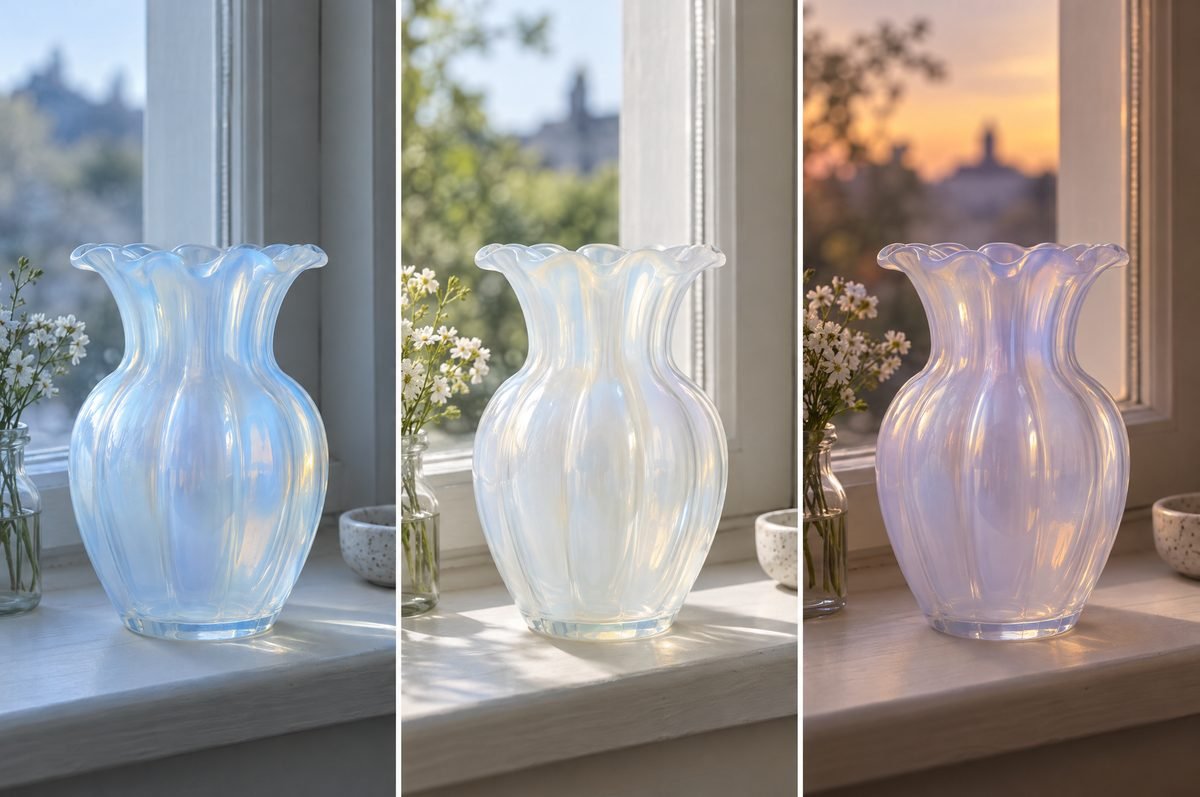
That is why an iridescent vase looks pale blue from the sofa and faintly pink from the doorway. It is also why the same object looks different at breakfast and at dusk. The light moves, and the colour moves with it.
Glitter works differently. It is many small flat pieces that each flash back the light. It catches the eye in bright points, which can feel busy in a calm room.
Soft iridescent finishes worth knowing
Pearlescent paint and glaze
Paints and glazes with fine, flat flakes that give a pearl-like glow. On a wall, they look almost plain in flat light and glow when light skims across them. Best on one smooth wall or a small area such as an alcove.
Opalescent glass
Milky glass with a soft inner glow and, often, a faint coloured flash at the edges. Lovely as a lamp shade, because the light passes through it and turns the whole piece into a small moon.
Lustre-glazed ceramics
Ceramic glazes with a thin metallic or pearly sheen on the surface. A lustre bowl or vase can show soft blues, golds and violets that change as you walk around it. One piece is plenty.
Mother-of-pearl
Nacre, the inner layer of some shells, is naturally iridescent. Small inlaid pieces on a box, a mirror frame or buttons give a gentle glow. If you choose real shell, ask what it is and where it came from.
Shot fabrics
In shot silk and some shot cottons and linens, the threads running one way are a different colour from the threads running the other way. The fabric seems to change colour as it folds and moves. A shot fabric curtain or cushion is iridescence in its softest form.
Dichroic glass and film
Glass coated with very thin layers that let one colour through and reflect another. It is bolder than the others, so treat it as your single statement piece. A small dichroic vase or a strip of film on part of a window can throw moving colour onto a wall.
Glitter versus glow: a quick check
Ask these three questions about any shiny thing you are thinking of bringing home.
- Does it sparkle in points or shift in waves? Waves are calmer.
- Can you see it from the door? If it shouts across the room, it is probably too much.
- Does it still look good on a grey day? A good iridescent finish looks quietly pale in flat light, then comes alive when the sun appears.
Where to put your one iridescent piece
Iridescence needs moving light. Good spots include:
- A shelf or sill that gets morning or late afternoon sun, out of the strongest midday glare.
- Beside a lamp, so it glows at night from the side.
- In a hallway or landing, where you walk past it and see it change.
- On a bedside table, where you see it in two lights every day: waking and falling asleep.
A small safety note: keep glass objects, especially round ones, away from direct sun on window sills next to curtains or paper. A curved glass surface can focus sunlight onto one hot spot.
Keep the base calm
An iridescent finish only looks special if the room around it is quiet.
- Keep walls matte and pale, in pearl, ice or soft silver grey.
- Choose matte or softly textured fabrics for most of the room.
- Keep surfaces clear around the iridescent piece. Give it space.
- Avoid mixing iridescent pieces with lots of chrome, glossy tiles and mirrors in the same view.
The rule we use is simple: one shimmer surface, calm base.
Try this: the three-light test
Before you decide where an iridescent piece lives, do this.
- Put it in the spot you have in mind.
- Look at it in the morning, at midday and at dusk.
- Then look at it under your evening lamp.
- Note when it looks best. If it only looks good once a day, try another spot.
- When you find a place where it looks lovely at least twice a day, leave it there.
This takes one day and almost no effort, and it tells you more than any product photo.
What to skip
- Large areas of rainbow holographic vinyl. It can tip into a party look quickly.
- Iridescent fabric plus an iridescent wall plus iridescent glass. Choose one.
- Neon-bright colours. The Extra Celestial palette stays in pearl, ice, lavender, mint and silver.
- Chunky glitter paint. The sparkle is lovely on a card, but hard to live with on a wall.
The free Extra Celestial Starter Guide shows each finish as a sample, with where to use it and how much to keep it to. You can get it here: the free Starter Guide.
Let the light do the moving. One soft, shifting finish on a calm base is enough to make an ordinary room feel a little further from home, in the best way.